
THE EVOLUTION OF TOOLS: HOW TECHNOLOGY IS CHANGING THE INDUSTRY
Power tools have come a long way in recent years, especially cordless tools. Advances in tool and battery technology have improved performance, boosted productivity and enhanced safety.
High voltage power
The last decade has seen the power and capabilities of cordless tools expand significantly. What was once a job for corded or petrol-powered tools is now possible with cordless alternatives due to the higher voltage, high performance tool platforms. For example, the Makita XGT 40Vmax platform is designed to deliver the output and run times that professionals need, even for the most demanding tasks.
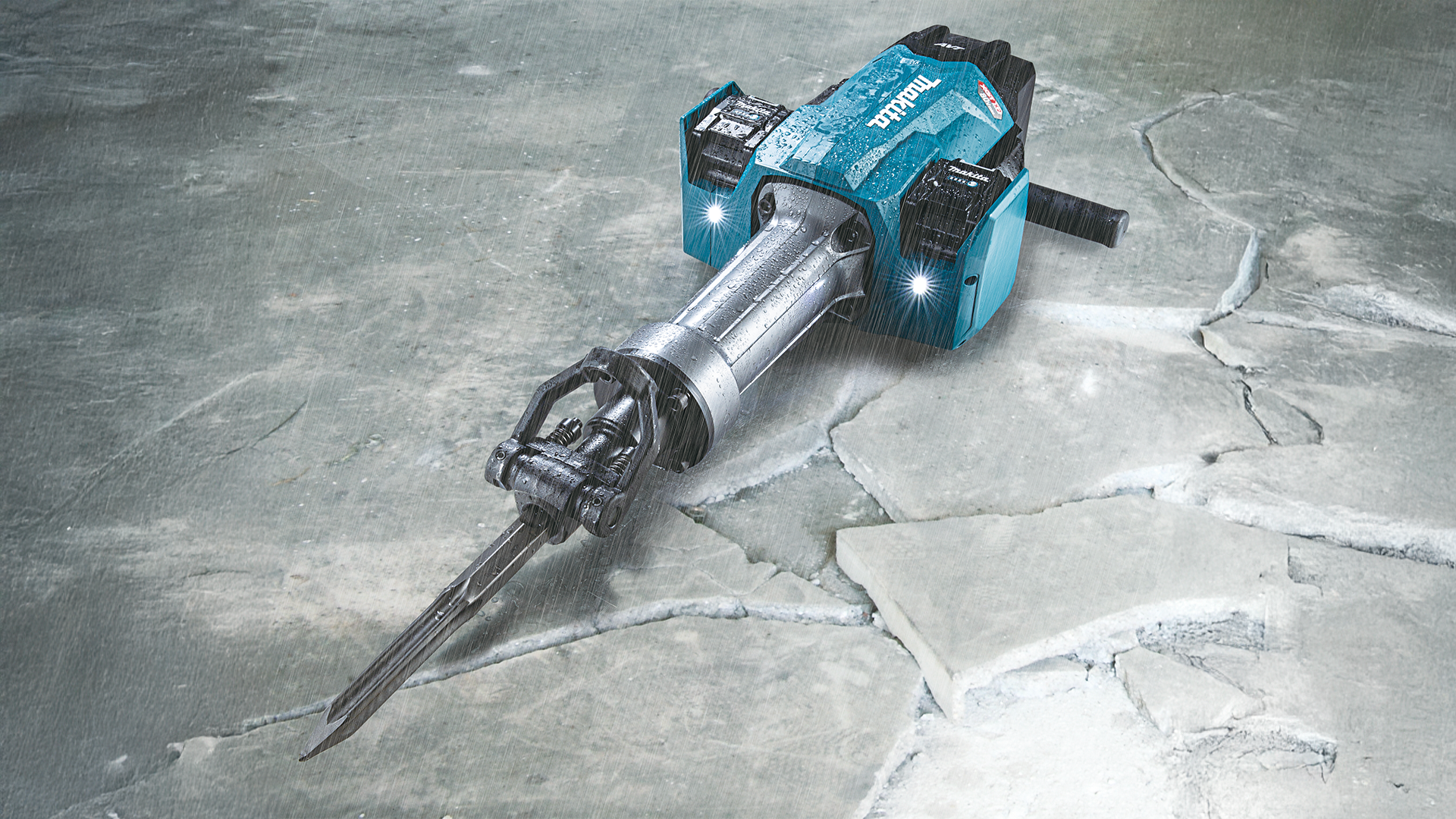
An excellent demonstration of this is concrete breaking, among one of the most demanding applications and traditionally the domain of mains powered machines. However, there are tools such as the Makita HM004G 80VMax (2 x 40VMax) Breaker XGT, which can match the performance of corded alternatives with 72.8 joules of impact energy at a rate of 870 blows per minute (bpm).
However, due to advances in technology, handheld tools from these higher voltage ranges are not bulky or hard to handle. Makita’s XGT tools are engineered to be compact and balanced with many having only a minimal or even zero increase in size over the LXT (18V and Twin 18V) versions.
Brushless motors
One of the innovations that has made tools more powerful, efficient and compact is brushless motors. By eliminating the friction and associated wasted energy that comes with a brushed motor, a brushless motor produces more torque per weight and requires less energy to achieve the same result. In fact, a tool with a brushless motor can extend run times by up to 50% per battery charge, meaning fewer recharges during a day’s work.
Cutting edge batteries
There have been several generations of battery technology for cordless tools, from nickel-cadmium (NiCd) through nickel-metal hydride (NiMH) to the current lithium-ion (Li-ion) batteries. Even now, battery technology continues to advance with Li-ion batteries now substantially better than when they were first introduced.
One of the latest advances is tabless lithium-ion technology. The tabless cells, such as those in the new Makita BL4040F, eliminates the bottleneck caused by current concentration by connecting the entire end of the electrode to the end of the cell, instead of connecting to tabs at each end. This ensures better energy delivery, longer runtimes and cooler running on very high demand applications. The tabless 4.0Ah BL4040F battery delivers up to 36% longer runtimes and operates 32% cooler compared to the standard 4.0Ah BL4040.
Safer working
The evolution of tool technology has also made the machines safer and more comfortable to use. One of the most important hazards that must be managed is vibration, especially with tools such as demolition and rotary hammers. High levels of vibration can cause serious damage to bones, nerves and blood vessels in the hands and arms leading to Hand-Arm Vibration Syndrome (HAVS).
To help manage this risk, tools from leading manufacturers will include features to minimise tool vibration. For example, Makita’s Anti Vibration Technology (AVT), built into selected tools, consists of a range of measures such as counter-weights, damper springs and vibration absorbing housings. When combined these significantly reduce the vibration transferred to the user’s hands, allowing the tools to be used safely for longer.
Dust is another issue that needs to be managed effectively and where advances in cordless tool technology has made a significant difference. For many years, dust extractors with power take-off have included features that allow the extractor to run automatically with a corded tool when it is in use. This makes dust management much simpler and more effective. The same automatic operation is now available with cordless tools. For example, Makita’s Auto-Start Wireless System (AWS) connects compatible tools and extractors together using Bluetooth to run the extractor automatically.
For extractors with power take-off but no built-in Bluetooth connectivity, there are also adaptors available to allow the connection to the compatible cordless tools. In addition, for even greater flexibility, there are now cordless M-Class dust extractors available – eliminating the inconvenience – and potential trip hazard – of connecting the extractor to mains power.
The continual evolution of cordless power tools means high-quality products can now deliver better performance, runtimes, productivity and safety. Find out more here about our XGT, LXT and CXT ranges of cordless tools.